
Events & installations7 min read
How a floral installation stays perfect for three weeks
The short answer
The mechanics behind my 21-day fireplace at Somerset House: hidden water, no fixings, a foliage base that outlasts the show, and flowers planned to be replaced.

A fresh floral installation lasts three weeks because of its mechanics, not its flowers. Every fresh stem needs a hidden water source, the structure must carry its own weight without touching the building, the base should be foliage that outlasts the show, and the flowers on top are planned to be replaced. At Somerset House they were resupplied twice in 21 days.
At Somerset House you may not use a single piece of tape.
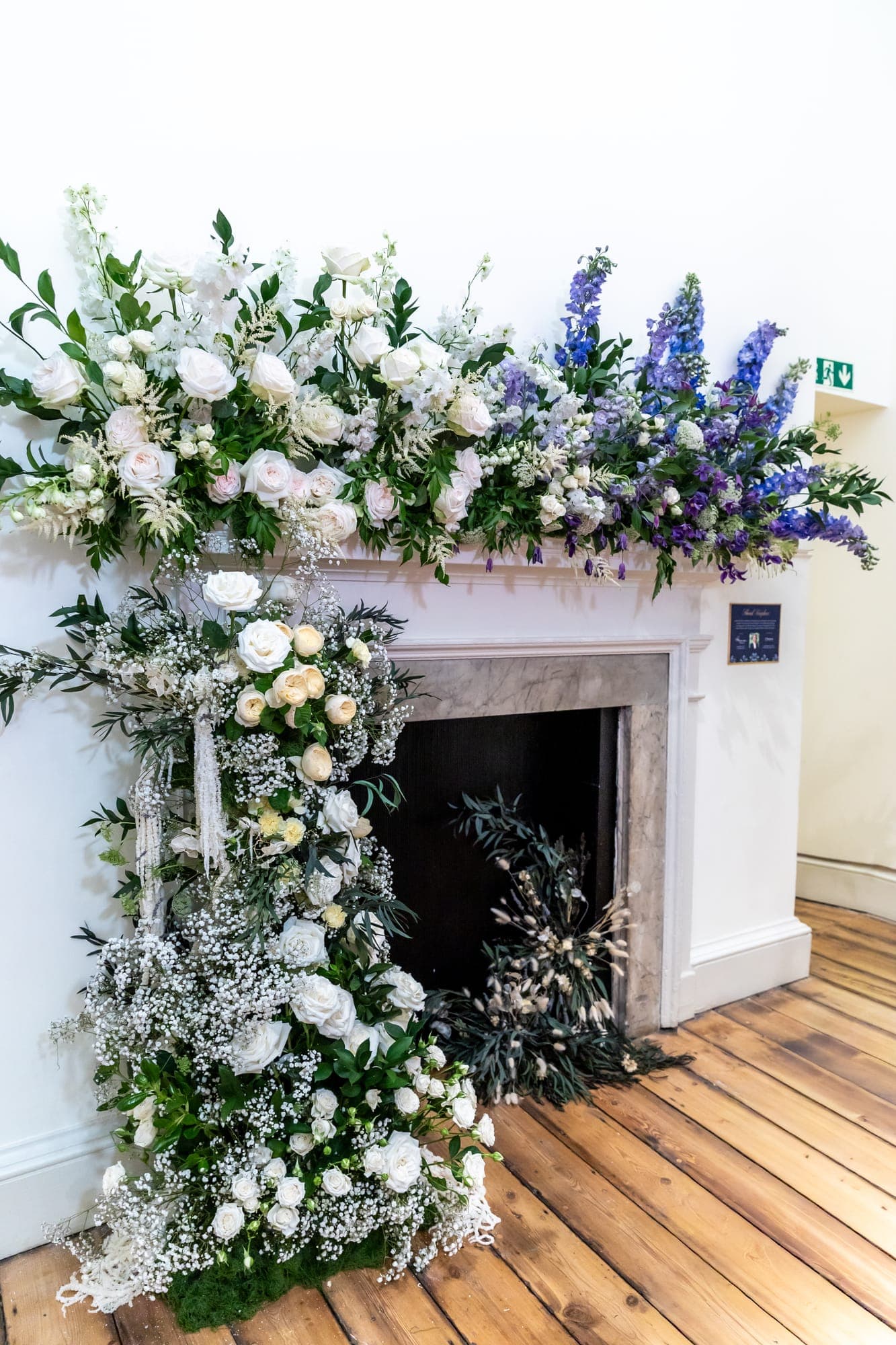
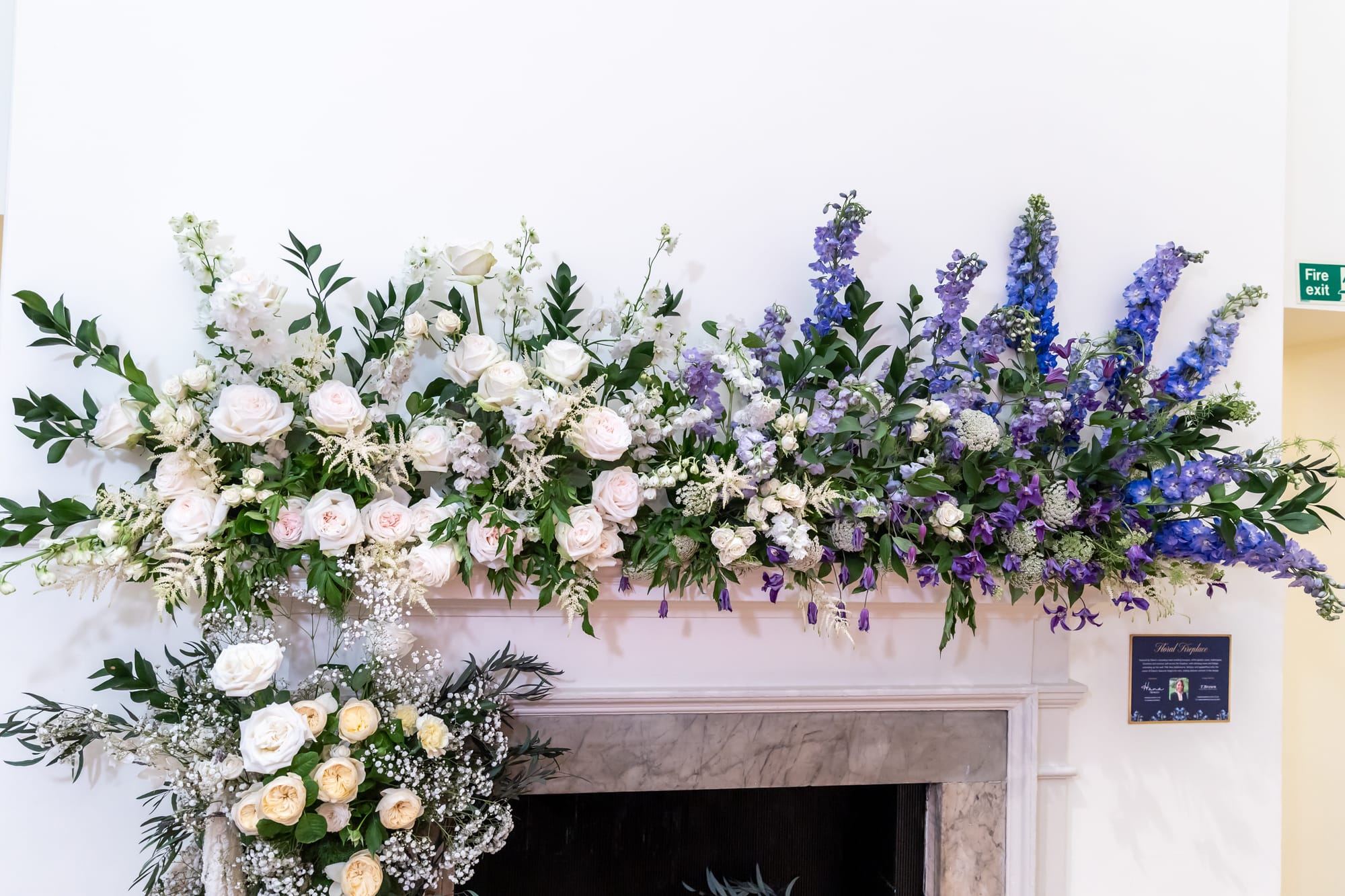
It is a Grade I listed building, and the rules for florists are precise about it: nothing can be attached or affixed to the fabric of the building, inside or out, including the floors. Not tape, not low-tack tape, not Blu Tack, not a nail. My fireplace for Fleurs de Villes DIANA is about 2.2 metres wide and 2.4 metres tall, it is made of more than two hundred stems, and it had to stand in a historic room for three weeks touching as little of that room as possible.
That is not a flower problem. It is an engineering problem that happens to be covered in flowers.
What florists mean by mechanics
Mechanics are everything in an arrangement that is not a flower: the frame, the water, the fixings, and whatever holds a stem at the angle you want for three weeks rather than three hours. When they are done well you never see them, which is precisely why they are so rarely discussed.
For a bouquet, the mechanics are your hand and a length of twine. For an installation meant to last, they are most of the work, and nearly all of the planning.
The rules that shape the build
Every serious venue has its own list. Somerset House's is a good one, and almost every line on it exists because something once went wrong.
| The rule | What it means for the design |
|---|---|
| Nothing fixed to the building | The structure has to be freestanding and weighted, never tied or fixed |
| Nothing touching historic fabric | A protective layer between flowers and marble, and a conversation with the organisers before you touch a mantelpiece |
| Waterproof material under every container | Nothing sits directly on stone or wood |
| Containers no more than a third full of water, and no water on site | You bring the water in, and you design for very little of it |
| Floral foam minimised and secured inside its container | It cannot crumble onto the floor or move |
| Chicken wire edges taped before you enter | No scratches on anything, including people |
| Misting with pure water only, over floor protection | No flower food sprays, no drips on historic boards |
| No peonies, geraniums or weeping flowers on marble or stone | Their petals stain it for good, and lily pollen does the same |
| Dried material fire-proofed in advance | Treated with a retardant such as Flambar, then flame-tested at the door |
| Nothing may protrude into the room | Fleurs de Villes' own rule, because visitors walk past within inches |
The staining rule is the one that surprises people. A peony dropping petals on a marble hearth is a lovely photograph and a very expensive afternoon.
Build it somewhere else
Everything in my fireplace was assembled in the studio and carried in finished. On the day there was no cutting and no construction, and the only tools on site were a pair of secateurs and a glue gun that had been electrically tested for the venue. No glass came into the building at all.
Building off-site is slower in one sense, because you are designing for a room you cannot stand in. But it means the room only has to put up with you for a morning, and it means every decision about mechanics is made at a bench, calmly, rather than on a ladder in front of an audience of organisers.
The frame itself is iron, on a weighted base, so it stands on its own without leaning on anything. Over it goes chicken wire, held with cable ties, which are the real fixings of the whole piece, with foam only where the design needed it, waterproof protection under everything, and water tubes for the most special flowers. I always build the water channels to connect to each other, so topping up is easier.
Water you cannot see
Fleurs de Villes does not allow a single vase or water source to be visible. So every fresh stem in the piece has to drink from something hidden. There are three honest options, and each costs you something.
Floral foam. It holds water, and it lets you place a stem at any angle, including hanging downwards, which is what makes a cascade possible. It is also a plastic that does not biodegrade and breaks down into small fragments, which is why Somerset House asks for it to be kept to a minimum.
Water tubes. A small sealed vial on the end of each stem. Ideal for a handful of statement flowers, impractical for several hundred, and each one needs topping up.
Chicken wire over hidden containers. Foam-free and reusable, but it needs containers deep enough to hide, which a fireplace surround does not always have room for.
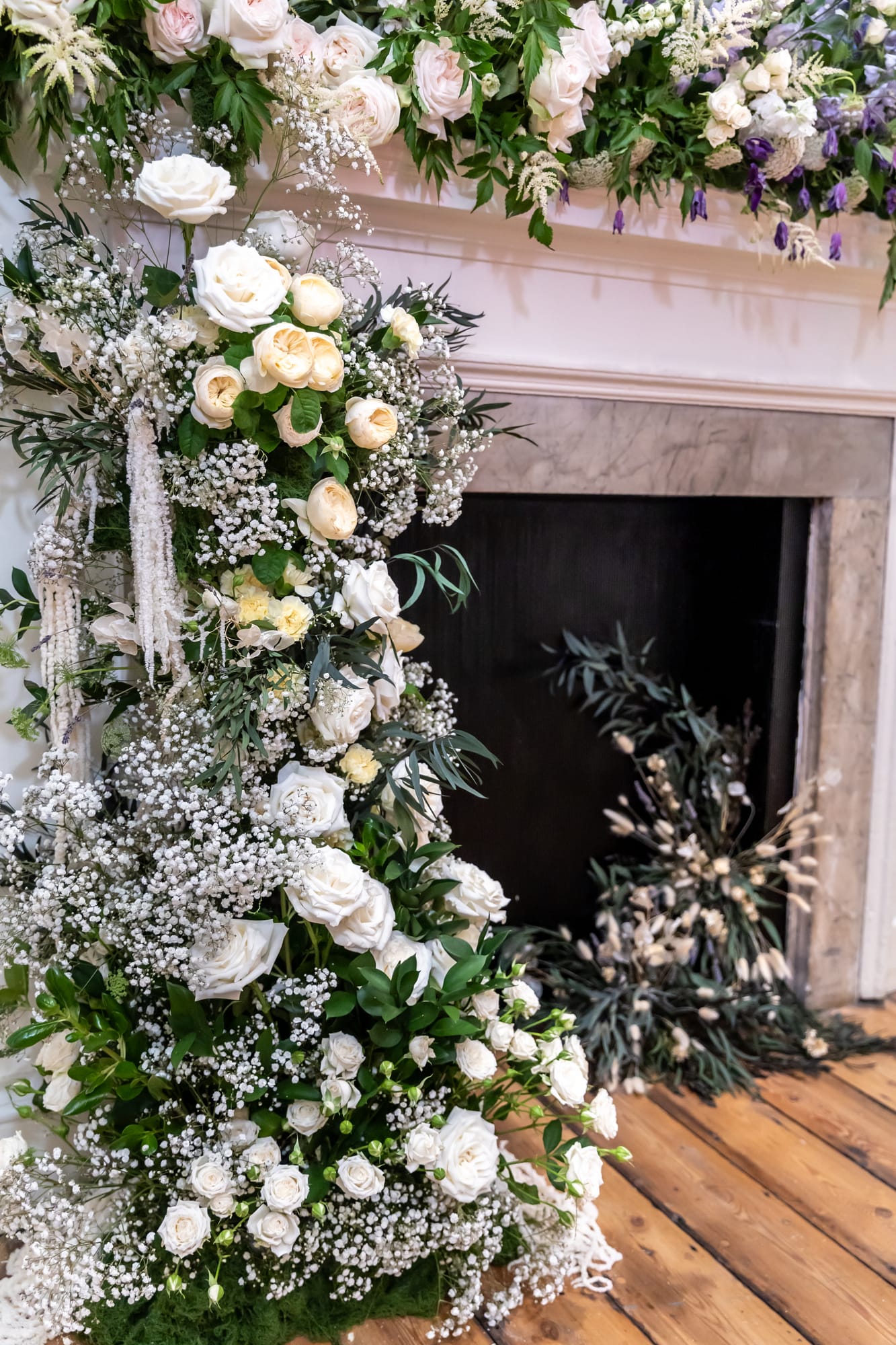
I am not a fan of floral foam, and I use it only when nothing else will do the job. This fireplace was one of those times. A cascade has to hold stems pointing downwards for 21 days, in a building with no water supply and no fixings allowed, and nothing else I know holds water at that angle for that long. So I used it, kept it to the minimum the design needed, secured it inside its containers, and took every piece of it away at the end.
Choosing flowers for twenty-one days
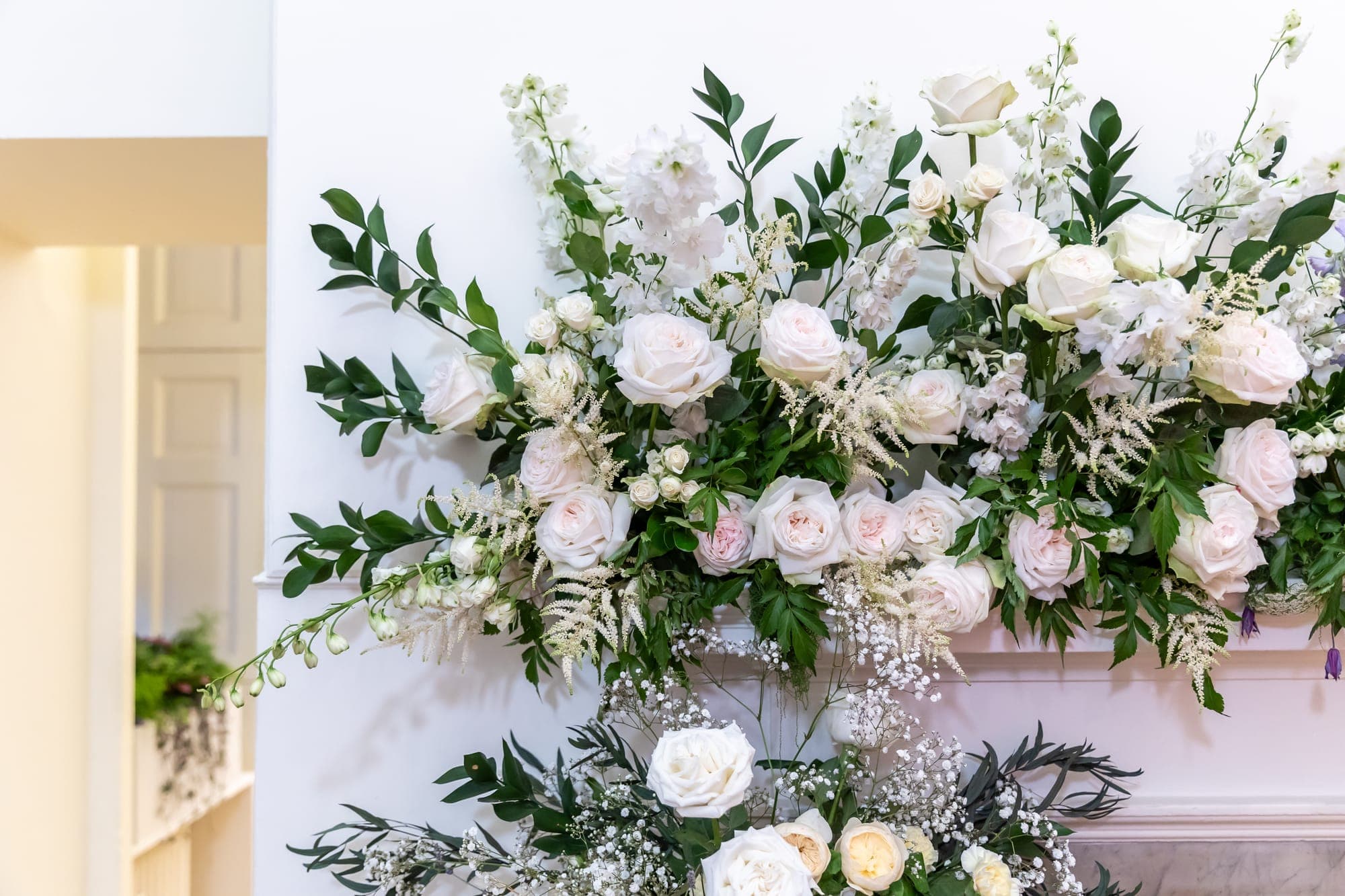
The single most useful decision in a long installation is to separate what stays from what gets replaced. The base is foliage that will outlast the show. The flowers on top are the part you plan, from the very beginning, to change.
| Material | Its job in the piece | Roughly lasts | Replace during the run? |
|---|---|---|---|
| Ruscus | Volume, and hiding the mechanics | Three weeks or more | No |
| Pittosporum | Body and cover | Two to three weeks | Rarely |
| Gypsophila | Softness and cloud | One to two weeks, and dries in place | Sometimes |
| White roses | The white base | Seven to ten days | Yes |
| Garden roses | Softness and scent | Five to seven days | Yes |
| Ammi | Lace and air | Seven to ten days | Sometimes |
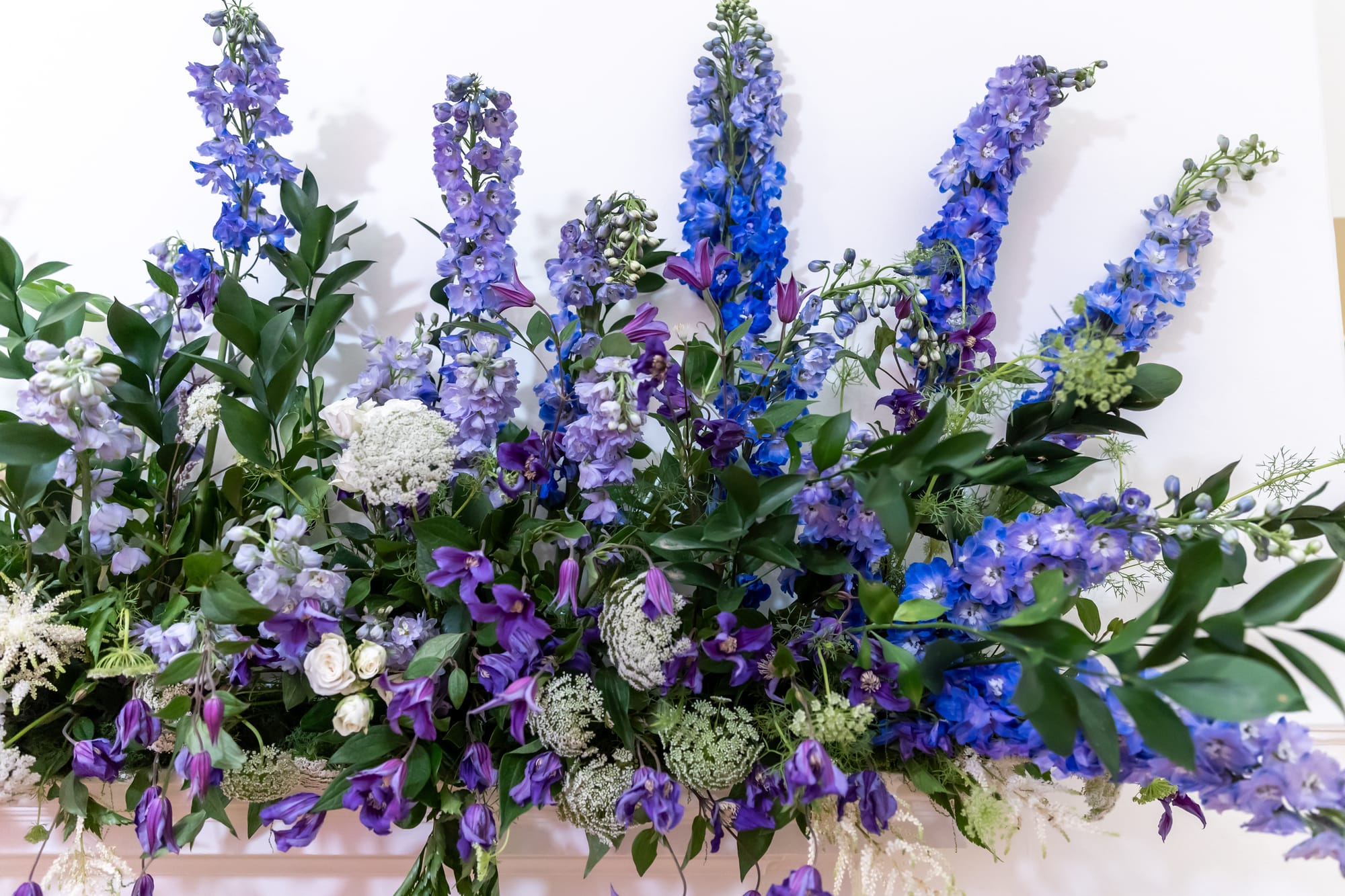
| Delphinium | Height and colour | Five to seven days | Yes |
| Clematis | Trailing movement | About a week | Yes |
| Dried grasses | Texture in the dark of the opening | Indefinitely, once fire-proofed | No |
These are rules of thumb for well-conditioned stems in a cool room, and conditioning matters here exactly as it does for the October flowers on a kitchen table. A warm gallery full of visitors is not a cool room, so I plan for the short end of every range.
Delphiniums deserve a word of their own. They are sensitive to ethylene, the gas that ripening fruit and ageing flowers give off, and they respond by dropping their florets all at once. In a closed gallery that is exactly the environment you have built. You choose them anyway because nothing else gives you that height or that blue, and you budget for replacing them.
The refresh
A three-week show is not three weeks of the same flowers. At Somerset House, fresh deliveries came through the wholesaler on 23 and 30 September, ordered two days ahead, and in quantities kept deliberately modest because storage in a historic building is limited and a maintenance team prepares flowers for every florist in the show.
I did the first refresh myself, a week in, because both the venue and the flowers are too delicate to hand over lightly. It takes proper maintenance tools and products, and mine come from the best supplier I know: Tom Brown supplies both the flowers and the flower-care solutions. An installation that has to stay up for three weeks is a real challenge for any florist, and the first refresh is where you find out whether you planned it properly.
The honest limit
You cannot make most fresh flowers last three weeks. Nobody can. What you can do is design a piece so that it looks exactly the same on day twenty-one as it did on day one, which is a different and more honest ambition.
That means choosing a structure and a foliage base that will genuinely last, accepting that the flowers you love most are often the shortest-lived, and pricing the replacements in from the start rather than discovering them in week two. If a florist quotes you for a three-week installation without mentioning a refresh, ask them about it. The answer tells you a great deal.
The best compliment an installation can get is that nobody wonders how it was done. The second best is a florist who stops and tries to work it out.
If you are planning an installation that has to look this good for longer than an evening, the conversation starts with the mechanics.
Photography by Veronica Castillo (@byveronicaphotography) for Fleurs de Villes.
Frequently asked
How long do floral installations last?
A well-built fresh installation can look perfect for two to three weeks, but not with the same flowers throughout. Long-lasting foliage such as ruscus and pittosporum forms the base, and the fresh flowers on top are replaced once or twice. A one-day event installation needs none of this; a gallery exhibition needs all of it.
What are floral mechanics?
Mechanics are the hidden structure of an arrangement: the frame, the water source, the wire and fixings that hold each stem in place. In a bouquet they are almost nothing. In a large installation they are most of the work, and they decide whether the piece is still standing, and still drinking, at the end of the week.
What can florists use instead of floral foam?
Chicken wire over hidden water containers, individual water tubes on key stems, moss, and reusable pin frogs are the main alternatives. Each is foam-free, and each has limits: chicken wire needs deep containers, and tubes are impractical in large numbers. Many venues, including Somerset House, now ask for foam to be minimised where it is used.
Do dried flowers need fire-proofing for an event?
Often, yes. Many UK venues require dried flowers and dried plant material to be treated with a flame retardant before they arrive, and some test it on site. Somerset House asks for treatment in advance and flame-tests dried material at the door to confirm it self-extinguishes; anything that fails is excluded.
Which flowers should not go on marble or stone?
Peonies, geraniums and any flower that sheds wet or coloured petals can stain marble and natural stone permanently. Lily pollen stains too, which is why historic venues ask for lily stamens to be removed before the flowers come in. Always put a protective layer between flowers and old stone.